
ポルトガル語はポルトアレグレで!?

ポルトガル語を真剣に学びたい日本人学生さんにポルトアレグレを推薦します。その5つの理由とは何か。

First impressions count

Before setting foot in the Porto Alegre I hadn’t fully pictured how the city should appear. Given the German/Italian immigration patterns I imagined...

Arte en Porto Alegre

Hablar de arte suele ser pretencioso de ante mano, a pesar de ello quiero mostrar mi interés. Aquí en Puerto Alegre me gusta la oferta cultural que tiene...

Avenida Borges de Medeiros - parte 1

Conheça alguns pontos turísticos importantes da cidade ao longo da Borges de Medeiros.

Curte uma trilha?

No artigo 'O outro lado do Morro Santana' um blogueiro abandona o desktop para trilhar o ponto mais alto da cidade. Será que ele conseguiu?

Memorial do Rio Grande do Sul

Conheça o belo Memorial do Rio Grande do Sul.

Mostrando postagens com marcador Virginia Warfield (USA). Mostrar todas as postagens

26/07/2011

Traveling

Lost in translation. Or a literal equivalent that is slightly unsettling, like two clocks ticking out of sync, or a picture hanging crooked on a wall.
As great as POA (Porto Alegre) may be, everyone always seems to want to get away from it, at least for a short time. ‘He’s traveling this week’ or ‘I will be traveling then’—I hear the word in this context on a daily basis.
But for me, ‘traveling’ brings to mind backpacking through Europe, or hiking around South America—something longer, more involved, perhaps even exotic. It’s not a visit to the seaside or a weekend in the country. I anticipate tales of foreign adventure, to find the topic is merely a visit to a relative in Curitiba or a beach house in Torres.
(Of course the pedant will say that ‘traveling’ denotes the act itself, and of course this is true, but you and I both know that is not the spirit behind its use in general conversation.)
Regardless, the weather has turned momentarily glorious, and the winter break is upon us, so we might as well do some traveling. (When in Rome, and all that…).
Up the mountain to Gramado we go. My in-laws have a history here, and I first knew it many years ago, before the expensive shops, restrictive parking and indulgent hotels. I prefer Canela these days; it feels more relaxed, and I’ve always liked the name.
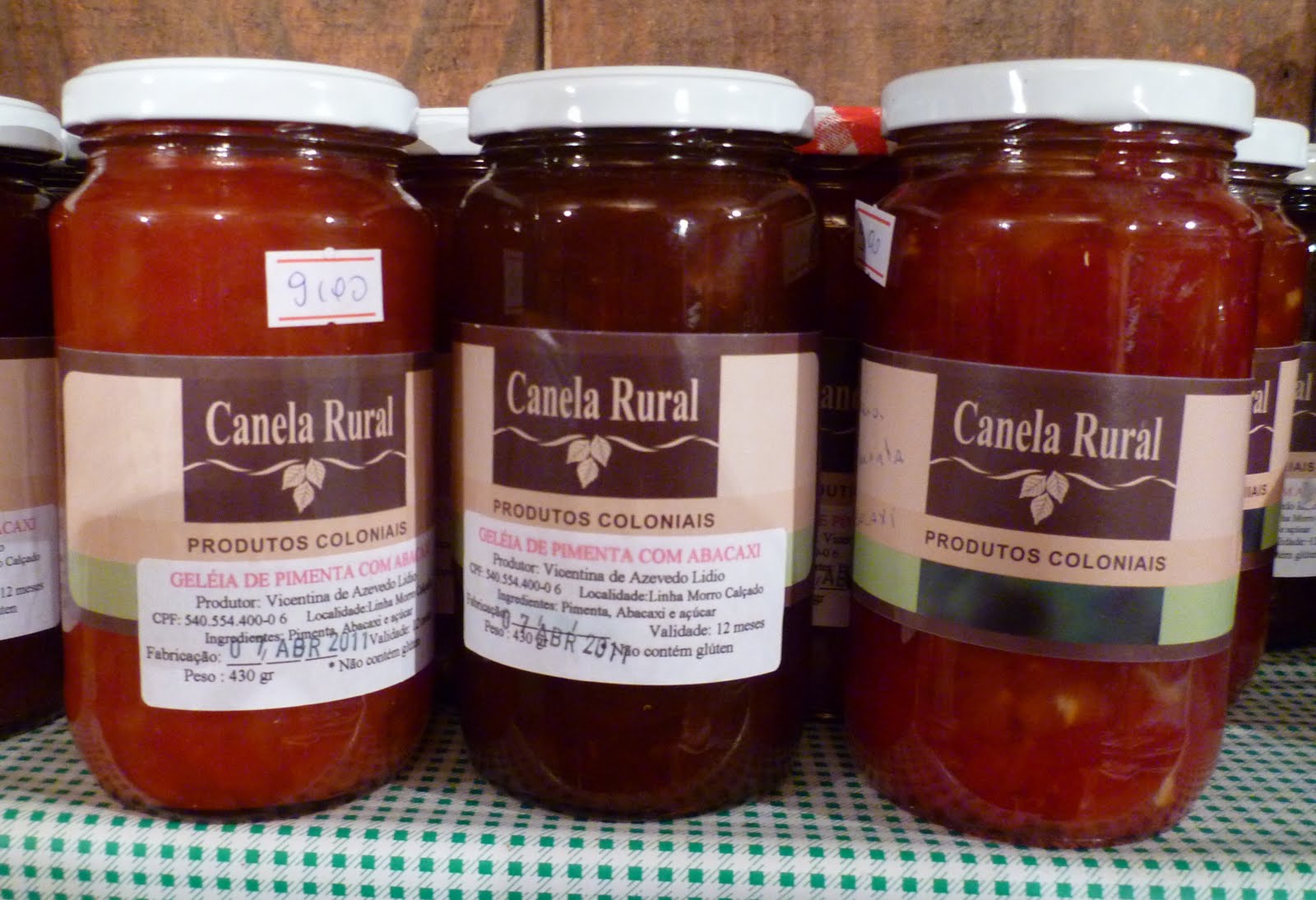
And there’s a Festa Colonial! Who needs overpriced gift stores when there are homemade jams and local products? When there are artisan craftspeople and lively musicians? When you can sample creamy chocolate, cinnamon cachaça, freshly-pressed fruit juices? Where the steaming quentão (a kind of mulled wine) is elegantly-spiced and silky smooth (unlike a sickly-sweet syrupy version I had last month at a Festa Junina).
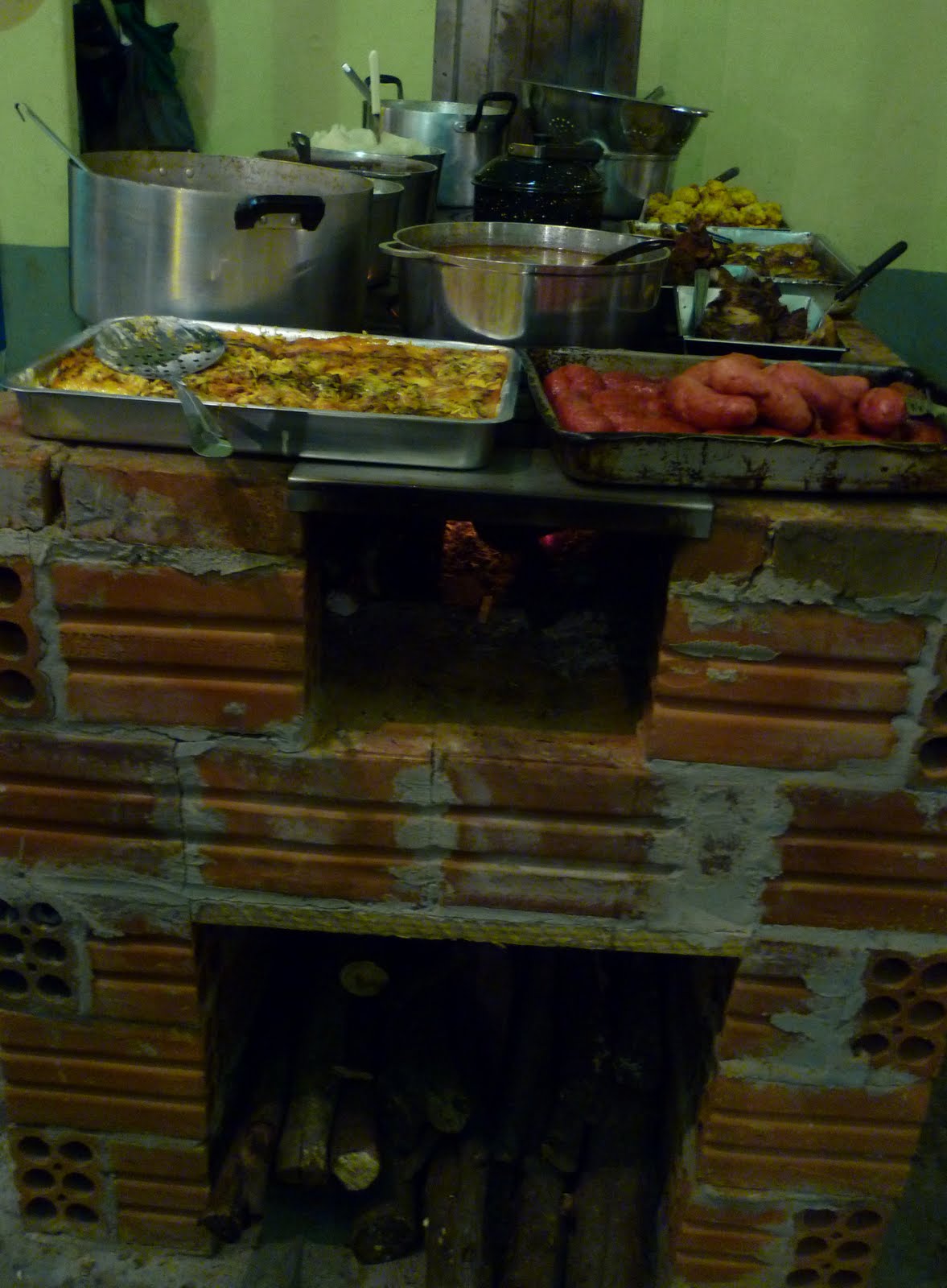
We had dinner at the festa—there are several caseira restaurants set up in the feira hall itself. Traditional, local, hearty dishes, served with a welcome as warm as the iron pots atop the wood burning stove. We bought jams and juices, chocolate and cachaça, and local wine, so pungent and grapey it was almost unreal.
Traveling? Yes please. I know there’s no place like home, but it is wonderful to get out and about now and then, even if it’s just a quick trip up the mountain.

20/07/2011

Bureaucracy

Bureaucracy. Red Tape. The System. Or ‘burro-ocracy’, as I have also heard it called—no one feels it quite like a foreigner in Brazil.
It starts out easy enough. If you come from a country that doesn’t need a visa to enter Brazil, you just turn up at the immigration desk, your passport is stamped, no questions are asked, and no information is given.
But how long can you stay? Are you allowed to work? Can you extend your visit, or what happens if you overstay your welcome? These are the mysteries of the tourist visa.
My situation is different, as I am married to a Brazilian, but I have met many others in this situation. And the answers to the questions above, in case you are wondering, are, in order: 3 months; no; yes—although you cannot be here more than 6 months in 365-day period; and at the very least you will be fined R$ 8 per day of your ‘illegal’ time.
OK, but back to me. I could write an entire novella on my dealings with Brazilian bureaucracy, but I will just share one or two of my favorites so far. Firstly, as we were married in the UK, we knew we had to register the union here in Brazil. We also knew that no one would be too impressed by our ‘foreign’ marriage certificate, so we had it translated—word for word—by a ‘juramentada’.
At the cartório we were told this wasn’t sufficient--the document would need to be returned to London for certification by the Brazilian consulate there. Sigh. Several weeks and more money later, we returned with the marriage certificate, and its shiny new stamp on the back.
The woman looked at the paper suspiciously. She turned it over, and then back again. Where is the translation, she wanted to know. We handed her the one we had. No, she told us, you need a new translation. To include the new stamp. ‘But the stamp is in Portuguese’, my husband cried in disbelief.
And so it goes. A new translation, more money spent, and then the federal police get to do their part. You can work now, the official tells me. Fantastic! And I can finally get a bank account too? He shook his head sadly. Unfortunately, not until the full residency papers are finalized, perhaps 1-2 years. It’s a quirk of the system, apparently. You are allowed to work, but not to open a bank account. And many jobs require you to have a bank account into which they can deposit your pay…
You have to laugh, as they say, or else you cry.

15/07/2011

And if you still have room, how about a Feijoada?


Maris took us through her impressions of the Gaucho churrasco. My introduction to Brazilian cuisine was in London many years ago, when I first met my husband. He is half-English, and he was spending his early 20s in the vibrant UK capital, having a wild time and experiencing life outside of Rio Grande do Sul.

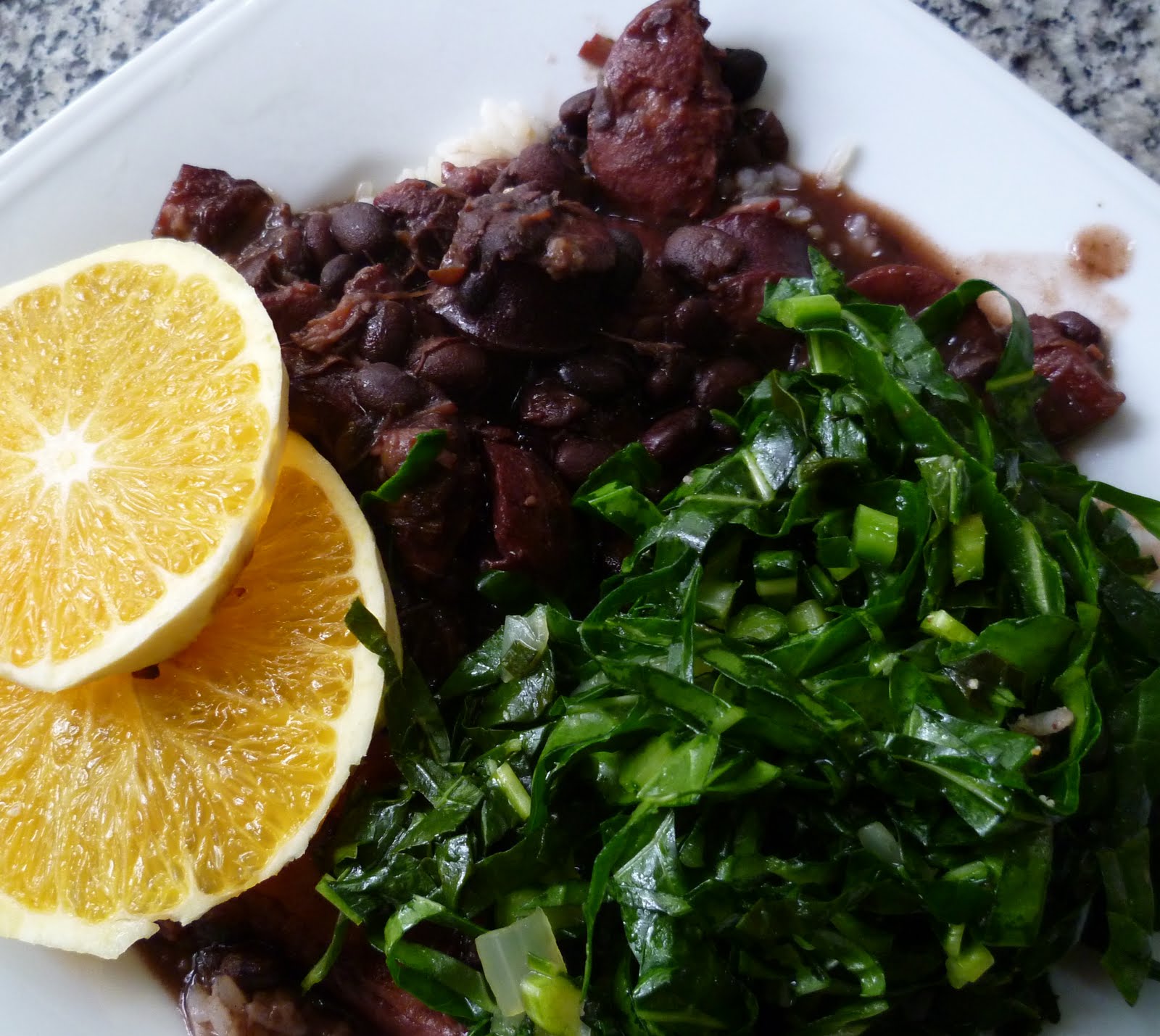
His big sister lived there also, and on Sundays we would make our way across the river for some family time and a feast like I had never seen before. The smell in her flat was incredible. ‘What IS it??’ I cried, when I first opened the pot and saw the velvetly black beans and chunks of meat and sausage. Her English boyfriend proudly told me that it had been cooking all day and I was in for a treat. He was so right.


They explained the ritual. The rice, the greens, the farofa, the oranges. Oranges? Why oranges? Apparently the vitamin C complements the iron…or something like that…but mainly because it just tastes good. I was in heaven. And of course I ate WAY too much… I think I could actually feel each one of those beans expanding in my stomach for the rest of the day!

Churrasco may be the pride of RS, but I think feijoada is the unofficial Brazilian dish. I’ve been told that it was traditionally a slave meal. Random discarded bits of the pig—ears, tail, snout, etc-- were cooked all day to produce the delicious stew, but it also may have originated from the Portuguese cozidos.


I joke that the main reason I agreed to come and live here was for the feijoada alone! When I lived in Australia it was difficult to get black beans, and I went a little crazy having them here in Porto Alegre when I first arrived. But now I skip them when I go to the buffets. I want to make sure that when I have the opportunity to tuck into a real home-cooked feijoada, I am ready to savour every mouthful.

11/07/2011

A chill in the air

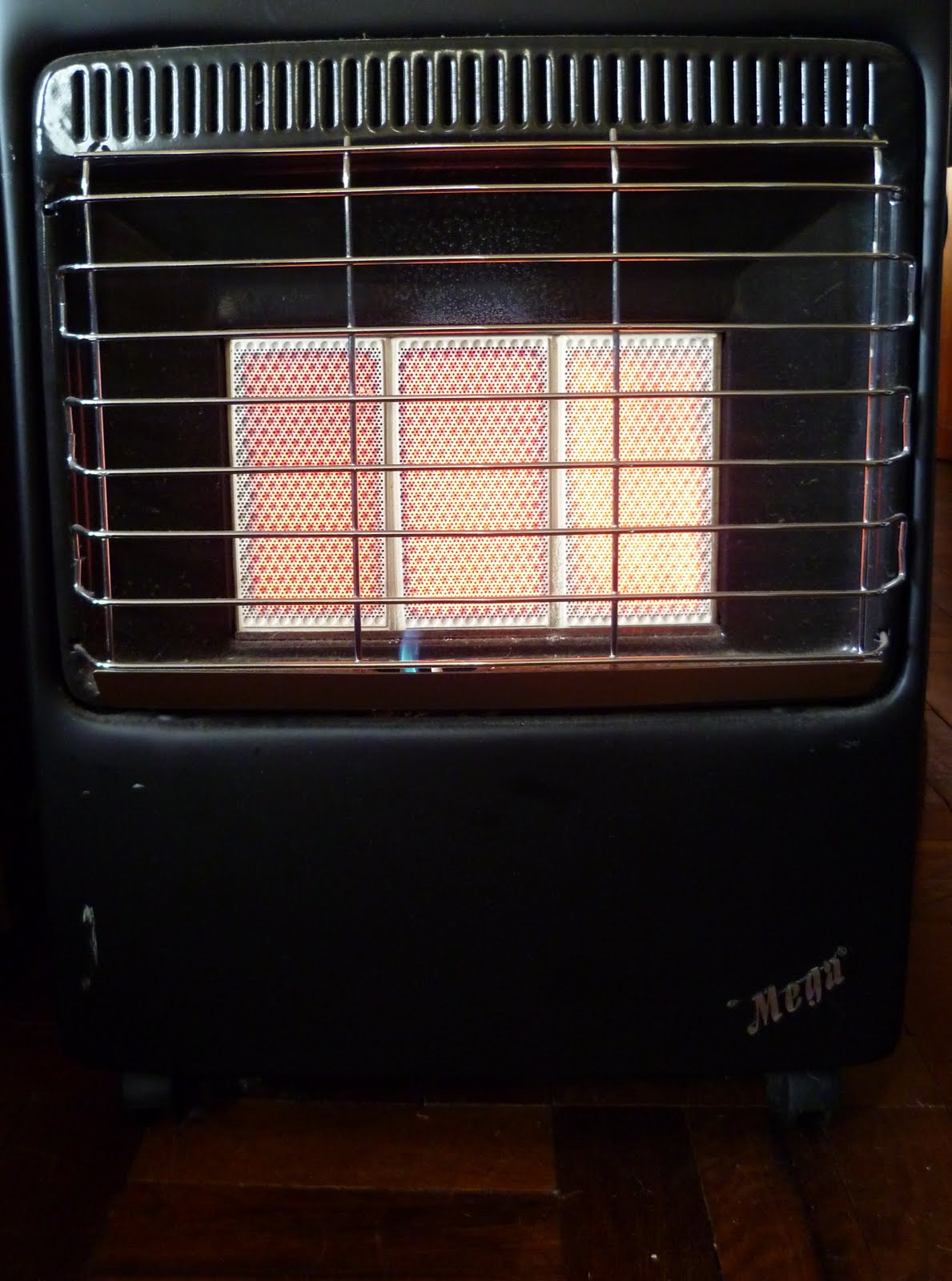
Baby it’s cold outside. Um, actually, it’s cold inside as well. And apparently it’s not just me who thinks so—everywhere I go, inside every shop, office, government building, I see people wearing their coats while they work. Where is the heat?!
Where is the fantastically-efficient gas central heating? The weather-smart insulation? Where are the cozy fireplaces? Where are the winter-warm shopping malls, buses, restaurants?
We live in an old building, and our apartment is pretty small, so it’s easy to keep it at a reasonable temperature. And we are still able to use an old-fashioned gas bottle heater, which, though bulky, is a cheap way to heat a room.
Best of all, when you run out of gas at 8pm, a simple phone call brings adelivery within 30 minutes! You gotta love that kind of service.
In many newer buildings, these gas bottle systems are forbidden, so occupiers must rely on alternative methods. Split air conditioners are becoming more common, but these can be expensive to run, and annoying to sit under, as the heat bears down on you like dragon’s breath. More often than not, I see the ‘splits’ silent and dormant on the wall. And that great apartment with the panoramic view? When winter comes, those glass windows are like sheets of ice.
But why is POA like this? Why are buildings so ill-equipped to deal with colder weather? It’s not as if this scenario were new. Presumably winters have always been chilly in southern Brazil. Regardless, most new constructions I’ve seen are no better set up—worse in many cases—than the older buildings. Are the engineers hoping for some kind of genuinely warmer global future?
As for me, at this point I’m just hoping for an early spring.

08/07/2011

Power in Numbers

Looking for something to do, eat, buy in Porto Alegre? How about going for parrilla in Moinhos or sushi in Cidade Baixa? Or trying a new experience—what about deep tissue massage, a photography course, or a weekend in Gramado? Maybe your car needs servicing, or your poodle needs pampering?
With so much on offer in and around the city, how could you ever afford to do it all? But what if we all got together and asked for a group discount? In these shaky economic times, who’s going to say no to guaranteed business? And buyers have always loved a bargain.
So, enter ‘collective’ or ‘group’ buying. In the past few years, consumer discount sites such as Groupon and Peixe Urbano have burst onto the scene. You can’t open your social network or browser pages without seeing ways to save on activities, restaurants, services. And savvy business owners are cashing in, realizing that this low-cost/low-risk advertising brings huge exposure and overnight increase in trade.
Groupon, in 23 countries worldwide, and one of the largest collective buying sites in the US, boasts that 97% of advertisers ask to be featured again. Here in Porto Alegre, it exists along with Peixe Urbano and others, as a reason many people across the city look forward to opening their emails each day.
Subscribers receive a daily deal, with discounts up to 90% on all kinds of businesses around POA. Each offer only becomes valid once a certain number of buyers is reached, and is only available for a limited time.
As a consumer, it’s a great way to explore new places and try new activities. In the past couple months, I’ve bought vouchers for pizza, cake, beer, bowling, an animal safari and a day spa. I got a new phone, an online DVD membership and a subscription to a magazine.
What kinds of things will you get with your next discount…?

04/07/2011

Park it here

It's a busy Monday morning in downtown Porto Alegre, and trying to find a place to park is as difficult as ever. We get lucky as someone is pulling out just in front of us, and even luckier as the 'flanelinha' hands us the departing driver's ticket, with 50 mintues still on it!
As it turns out, we only need half that, which is amazing for a visit to a government office. But as we return to the car, we realize we only have a R$1 coin to give our helpful friend. He is undiscouraged. 'Tá ótimo. Boa semana,' he calls out, smiling, then immediately turns his attention to the next eager recipient of our spot.
I'm fascinated by these guys. I'm bemused by the whole custom of having someone 'assist' you in parking your own car, making a theatrical show of rolling their hands to indicate turning your wheels, or shouting 'Pare, pare' in case you might hit the car behind you. Then they are waiting when you are ready to leave, assuring you that they have been guarding your car with their own lives.
'What do they do?' I asked when I first moved to POA in January. They look after your car, my husband told me. Why? For money, of course. Some of them seem kinda scary, I thought, suddenly appearing at your window in the dark. But they're harmless, people say. Unless you DON'T give them money... (though no one seems to know anyone who actually had a problem with any of them!)
Apparently it's a lot worse in São Paulo, where flanelinhas are very aggressive, and can demand inflated prices or even threaten you if you don't pay. Thankfully here they are generally quite friendly, and they cheerfully accept whatever small donations you give them.
Sometimes my husband tries to avoid paying, mumbling about having no change after the windows are already closed. I tell him he will get bad 'parking guy' karma if he keeps it up, and now I usually try to have some coins ready before we get to the car.
Everybody has to make a living somehow, right?

29/06/2011

You can't get there from here

My Argentinian co-blogger recently wrote about the transportation system in Porto Alegre. It's interesting that he made comparisons to Buenos Aires; I was there in March, and I felt like I knew my way around that beautiful city better after three days than I did in POA after three months!!
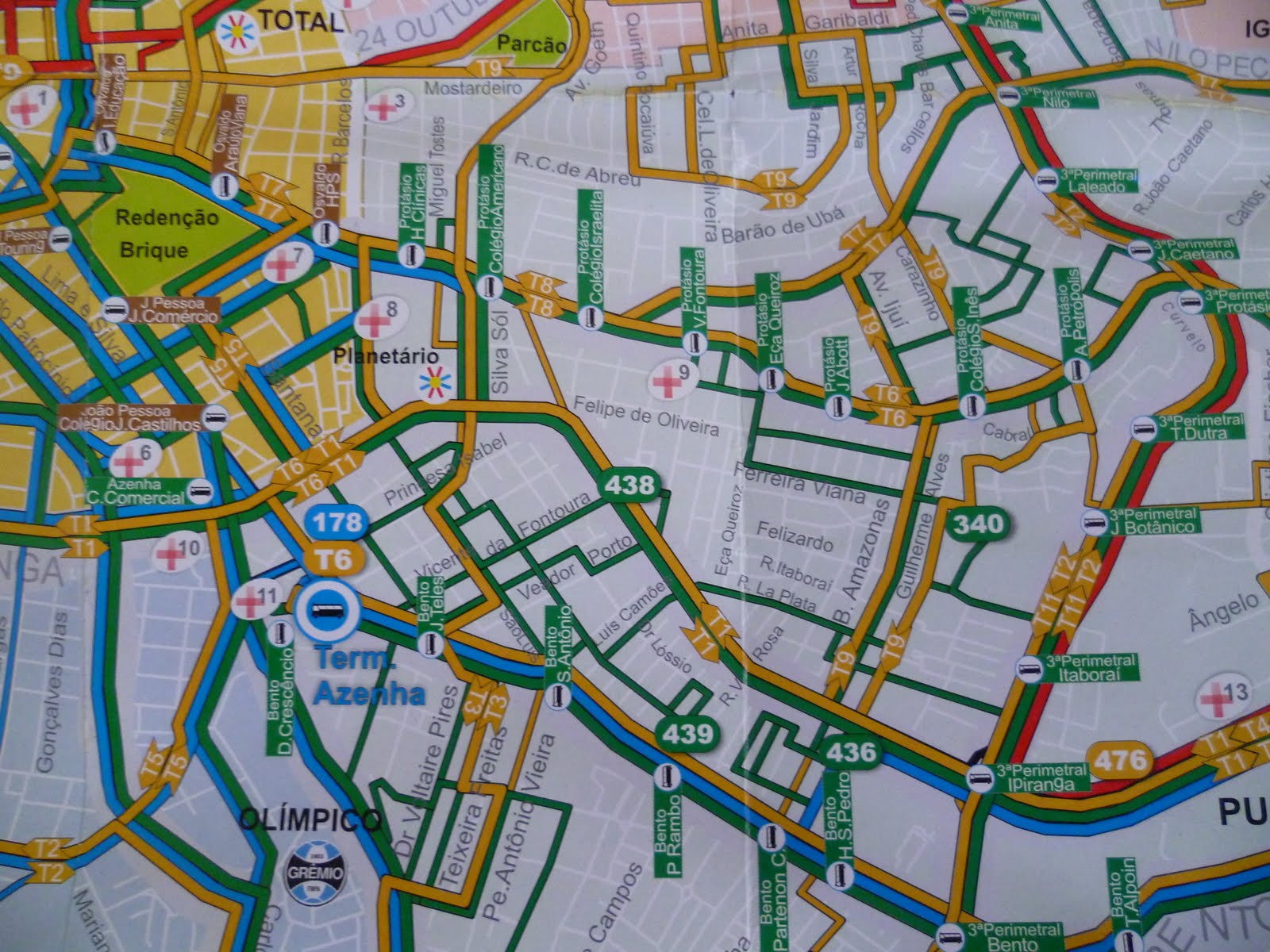
The dearth of useful information available here to the visitor—and resident—baffles me. There are few maps in circulation, and the layout of the city and its bairros seems to have no coherent pattern.
Worse still is the incomprehensible maze of public buses and the complete lack of travel guidance. It's like some sort of secret society, where you have to crack the code to enter. I am always asking 'How am I supposed to know WHICH bus to take to a particular destination?'
The answer is invariably the same. 'You just know.'
But there are no notices at the bus stops. There are no timetables, no destination charts. There is no bus map that makes any sense. The official eptc website is a myriad of confusion. Only if you know the exact bus number you want to look up can you find its route and schedule. And because there are four bus companies that don't seem to have any connection with one another, it's even harder to map out a course.
You can't just walk to the closest bus stop and see where you can go. You could flag down each bus and ask the driver, but what if you don't speak Portuguese? What if the very bus you need is just around the corner and no one tells you? What if you're the sort of person who wants to plan the easiest route ahead of time?
So how is a tourist supposed to navigate the city using public transport?? Many world cities have readily-available and easy-to-understand walking and transportation maps. Many public bus and train systems offer comprehensive guides in print or online, and most stops have detailed route information, including, in some cases, the arrival times of the next one approaching.
And why only a single-journey fare? Why is there no discounted weekly or daily pass, and why must one pay for EACH trip if a change of buses is needed?
Having said all this, once you figure out which bus you need, and where the stop is, and how to negotiate the turnstile and pay the fare, the bus ride itself it quite comfortable and efficient. I'm a huge fan of public transport, and I would like to use it as often as I can. But I think POA has some work to do to get ready for the influx of tourists in 2014.
links: PoaTransporte   eptc
phone: 118 for route information (Portuguese only)

22/06/2011

The Afiador

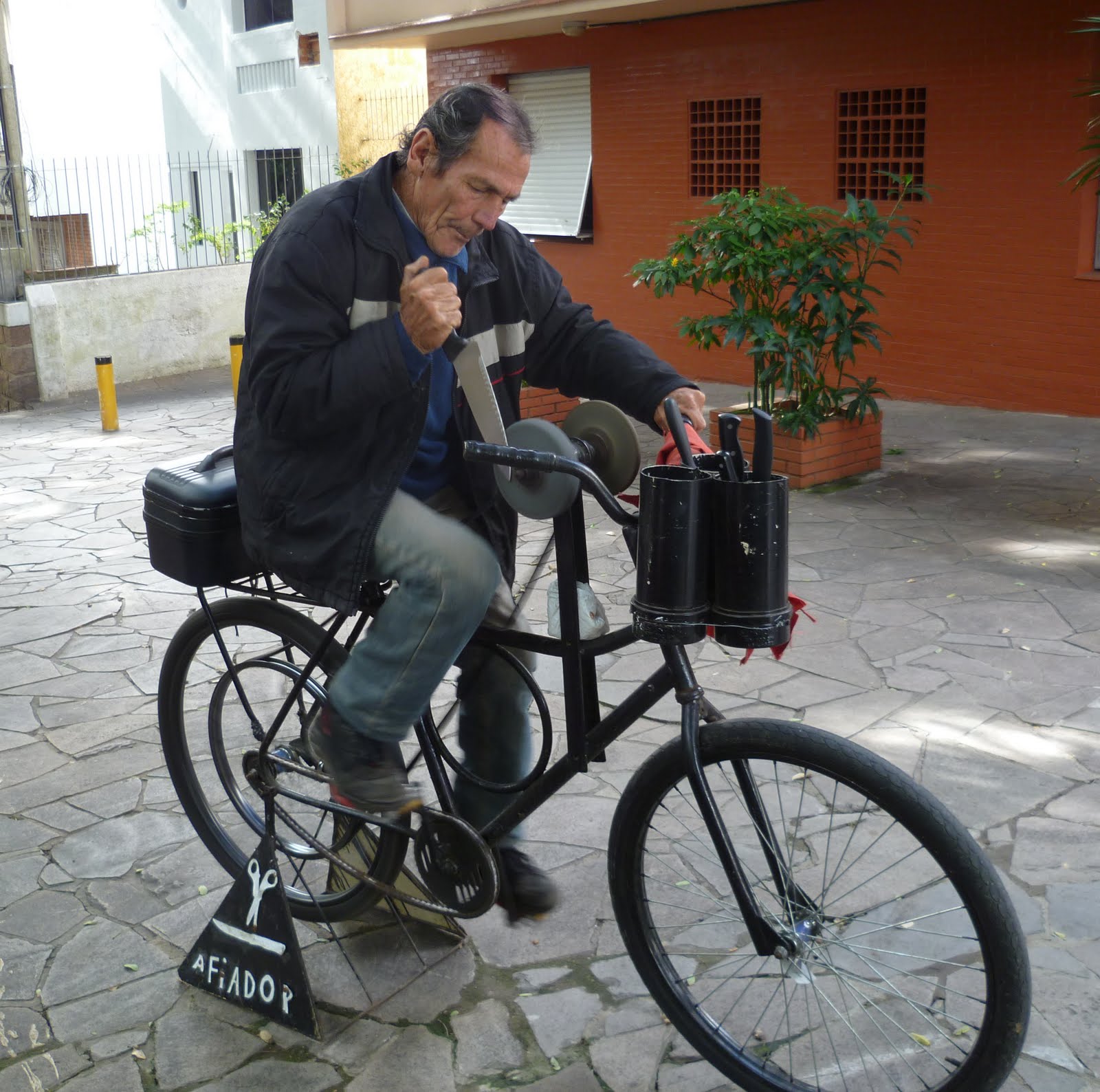
Things had been getting pretty dull around here, and something needed to be done about it. I'd been waiting for the man to come along and put the edge back into things, but I seem to keep missing him. Today, however, I was just sitting down to lunch when I heard the distinctive whistle from the street below. I quickly jumped up and grabbed all the knives I could find. Hurrah! The 'afiador' was in the neighbourhood!

I love a good knife. I've got knives in all shapes and sizes. But, as any chef will tell you, a blunt knife is not only useless, it's also dangerous. And not to put too fine a point on it, but my knives were in serious need of sharpening.

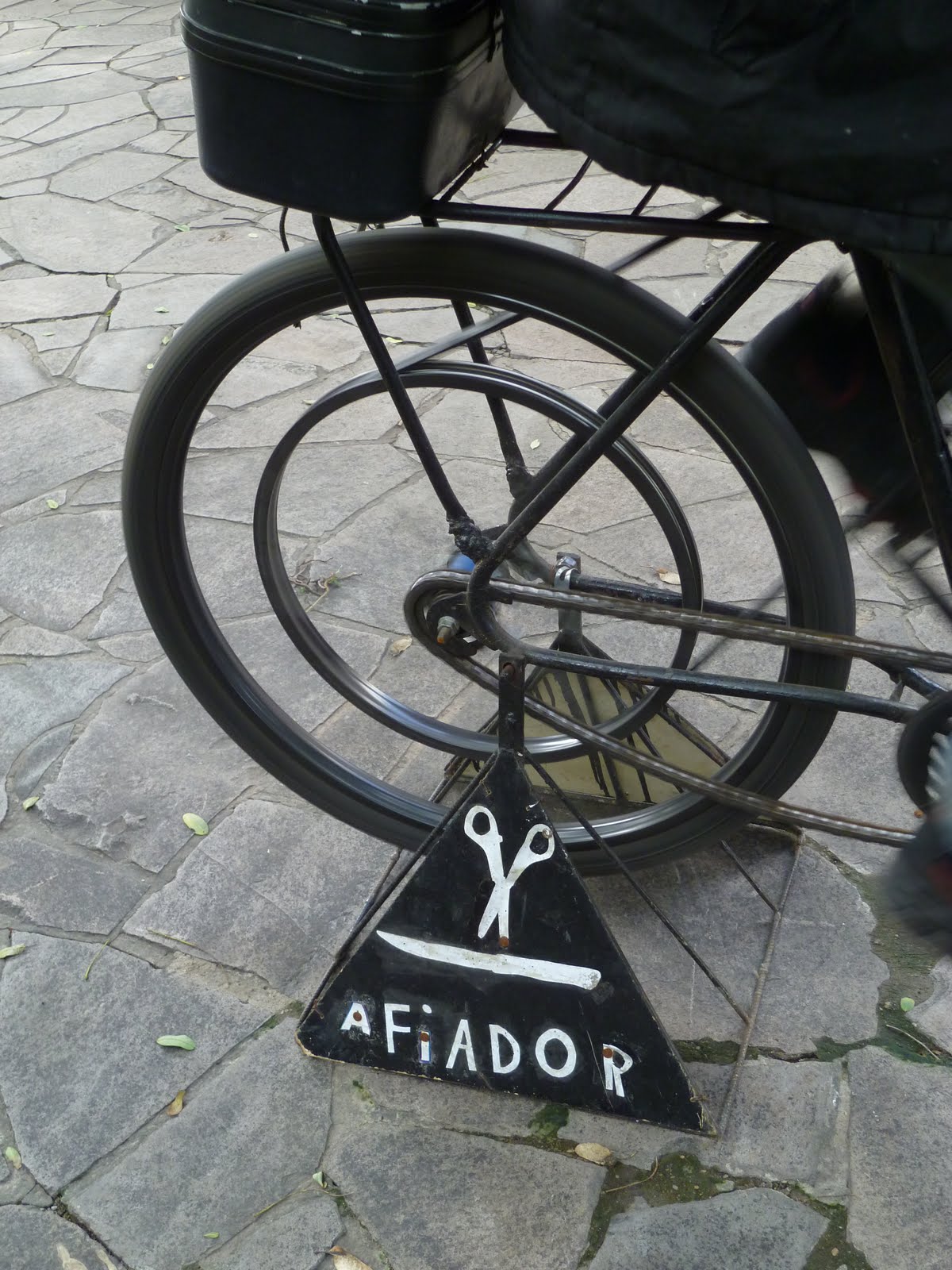
Adevade Augusto dos Santos bought his bike in 1969. He's been honing blades, reviving nail clippers and shaping scissors for 52 years. Sprightly and talkative, he's cheerful and chatty above the whine of the steel against the stone. And how's this for a 'green' energy source—he uses pedal power to turn the grinder and file, and all he has to do is hold the blade against them.

It cost R$ 4,00 per item—a bargain, I say, compared to the value of a decent knife. Adevade moves around; he also goes to the local restaurants and shops, summoning his regulars with his Pied Piper call and getting exercise as he works.

It may not be cutting-edge technology, but it's great to see an old-time tradition still deeply carved into modern life.

05/06/2011

Let's go shopping!

Whenever I visit a new country, one of the first things I like to do is check out the supermarkets. I love to see all the different products, the labels, the languages, what's available as fresh produce, etc.

The first thing that strikes me about places like Bourbon, Carrefour, Big, is, um, how BIG they are! I didn't expect hypermarket-style shopping here. I didn't expect to find entire aisles of just rice. I didn't expect to have friendly young people packing my bags at the checkout—I think that disappeared in the US around the time of 'Happy Days'!

And the most surprising thing for me so far: the accuracy of the receipts. OK, the prices may change every couple days, but what has been rung up is what was advertised. In other countries I've lived—USA, UK, Australia—I used to diligently check each docket before I left the store, and I ALWAYS found an error. But I can happily report that at my local Bourbon I have never seen a discrepancy between receipt and shelf price.

I do have one criticism though, and it is a big one. Those helpful young people who are packing my PLASTIC bags? Why why why do they have to use so many, why are they non-biodegradable, and why is Brazil so far behind in environmental issues?? Worldwide supermarkets are taking steps to minimise plastic bag usage: Tesco in the UK and Whole Foods in the US offer bags made from recycled plastic bottles; Woolworths and Coles in Australia encourage reusable polypropylene bags that customers dutifully tote around; global German chain Aldi doesn't give out any bags at all.

And yet seemingly, the supermarkets uses one plastic bag for each item purchased! Carrefour and Nacional are just as bad, and their bags are even smaller, so more are used. All of these stores do offer a small and uninteresting selection of reusable bags available for purchase, but I have found that even when I bring my own (international) shopping bags--and my old-lady shopping trolley--the stunned 'packers' are unsure what to do with them! Come on POA—make plastic go away!!


You might also like:

17/05/2011

What's cookin'?

Porto Alegre has some great food. It does. In fact, a friend said the food here is among the best she's EVER had. I certainly wouldn't go that far, but I have had some fine meals, particularly some 'caseira', or home-style, lunches cooked by other people's maids, or the bounty of dishes served at the amazing buffets around the city.

But, and this is a BIG but in my life as a self-proclaimed foodie, what I haven't had enough of—in the five months I've been living here--are great meals cooked by my own capable hands. And this is making me crazy. Because I love to cook. I love to eat too, obviously, but I also love to prepare meals, try out new recipes, enjoy restaurant-quality dishes at home. I love the yummy satisfaction that I can do it as well as they can.

And the reason for this gaping hole in my current culinary existence lies in what Porto Alegre DOESN'T have—and that is a workable array of key ingredients. Sure, you can get twenty types of shoyu at Zaffari, or you can pick up some packets of spices and a bulk bag of grains at the mercado público, but what about those other essentials of global cuisine? Where are the corn tortillas, the tangy salsas, the refreshing sour cream, the staples of Tex-Mex food? You're lucky to find fresh coriander when you need it.

I spent twelve years in Australia, where the influence of Asian cooking is seen on every menu, in every corner store, at every farmer's market—gorgeous zesty lemongrass, salty fish sauce, nutty satay, a hundred different noodles (and I don't mean types of pasta) and my own favourite, the treacle-thick kecap manis, the sweet soy from Indonesia. Even in the smallest cities you have access to ingredients for Japanese, Thai, Vietnamese, Malaysian, Chinese food.

Before Australia I lived in England, so don't even get me started on Indian cuisine. My mouth waters for a great curry, but that is one style of cooking I usually leave to the experts. I was disappointed by a local take-out service, so I decided to make it myself. Curry pastes would be an easy way to start, but they are nowhere to be seen. Ok, with a mortar and pestle, I'll just buy the spices and get started. Cumin—love it, easy to find, good for Moroccan food too. We're on our way. Whole cumin seeds? Harder, but not impossible. Coriander seeds? Fenugreek? Search around the market and we're getting there slowly. Turmeric? Now we've hit the wall. That looks like it MIGHT be it—after all, it's pretty distinctive—but not even my translator husband knows what 'circuma' is, and neither do the people selling it.

I could go on, but you get the idea. And you're probably getting hungry too. I know I am. It's midday, so it must be time to head to the buffet, with the scores of office workers, locals, parents, kids, and me. I may not be able to cook what I want, but I certainly won't go hungry.


You might also like:

 
Real Time Web Analytics